Category Archives: Individual Wellness & Personal Growth

Mental Wellness & Personal Growth Articles

Learn about mental wellness and personal growth with research-backed insights to improve well-being. Explore mindfulness, stress management, self-care, and emotional resilience techniques to cultivate a more fulfilling life. Discover practical strategies to enhance mental clarity, build self-confidence, and foster long-term emotional health.

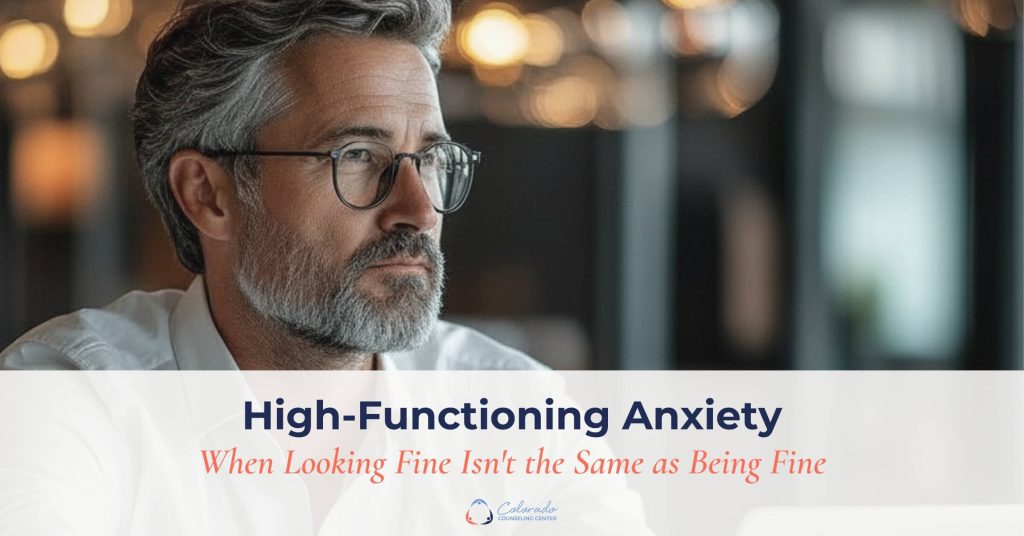
High-Functioning Anxiety: Signs, Causes & Why It Gets Missed

Man in his 50s gazing thoughtfully to the side, appearing composed but internally distracted, representing high-functioning anxiety

What parades as perfectionism often has deep roots in fear and anxiety — though most people wouldn’t describe it that way until something breaks.

Maybe that’s true for you at work. Maybe it shows up instead in how you run a household, raise your kids, show up for a creative practice, or carry yourself through school. High-functioning anxiety doesn’t only wear a blazer. It can look like any life where nothing is allowed to fall apart or be less than exceptional.

From the outside, you look like someone who has it together. You meet deadlines before anyone has to ask. You’re the one people call when something needs to get done right. Your calendar is full, your standards are high, and by most measures, you’re doing well.

But something else is happening underneath. Your mind doesn’t quiet down when the day ends. Rest feels harder to access than it should. There’s a low hum of tension that follows you even after your tasks are finished. Relief doesn’t quite arrive — there’s just the next thing waiting.

This is what high-functioning anxiety often looks like: not visible distress, but a kind of constant motion that gets mistaken — by others, and often by the person living it — for drive and success.

Continue reading


How Do You Discover Your Authentic Self?

Woman writing thoughtfully by a rain-streaked window, a quiet moment representing the journey to discover your authentic self

Many of us carry a quiet sense that there’s a more genuine way to live — one where who we are on the inside matches who we show up as in the world. Discovering your authentic self starts with noticing that gap: the exhaustion, restlessness, or feeling of performing a version of yourself that isn’t quite true.

That discovery isn’t about becoming someone new or ignoring real life. It’s closer to remembering — uncovering what’s already there beneath the roles, expectations, and old survival strategies that have accumulated over time.

Continue reading

What If My Partner Doesn’t Want to Go to Couples Counseling? A Guide for the Partner Who’s Ready

Foggy stone path leading toward misty mountains at sunrise, symbolizing hope and moving forward when your partner won't go to couples counseling

You’ve been the one carrying it — noticing the distance, naming what’s wrong, wanting something to change. And when you finally suggested couples counseling, your partner said no. Or maybe they didn’t say no exactly, just changed the subject, or agreed in theory and never followed through.

It’s a particular kind of lonely, wanting to work on something that takes two people, while only one of you is reaching for it. You might be wondering if that means the relationship is doomed, or if there’s something you’re supposed to do differently to get your partner on board. Neither is quite right. A partner’s reluctance says something about them — their fears, their history, what therapy means to them — not about whether your relationship is worth fighting for. And it doesn’t mean you have to wait, frozen, until they’re ready.

Continue reading

Why Can’t I Stop Watching Pornography? The Pull, the Pattern, and the Path Forward

Sunrise breaking over an open grassy field with the text "Why Can't I Stop Watching Pornography? Understanding the Pull — And the Path Forward"

Maybe you’ve tried to stop watching pornography more times than you can count, and it never quite sticks. Maybe a partner just found out — or has known for a while — and you’re both trying to figure out what comes next. Or maybe you’re not in a relationship right now at all. You’re simply tired of how much room this has taken up in your own life, on your own terms.

Wherever you’re starting from, this isn’t a post about whether pornography is right or wrong. If that’s genuinely the question sitting with you, our post on is pornography bad goes there directly. This one starts somewhere different — closer to the question underneath: why does this have so much pull, even when part of you wants it to stop?

That pull is real, and it’s rarely about willpower. Telling yourself to simply try harder, want it more, or have better discipline hasn’t worked — not because you’re weak, but because that’s not actually what’s driving this. Something else is happening underneath, and understanding what that is tends to matter far more than any amount of self-criticism ever has.

Continue reading

Chronic Pain Isn’t Just Physical. Here’s Why That’s Actually Good News.

Brain with heart icon representing the mind-body connection in therapy for chronic pain at Colorado Counseling Center

When the Body Heals But the Pain Remains

You did everything right. You saw the doctors, followed the treatment plan, went to physical therapy, maybe tried acupuncture or massage or yoga. And yet — the pain is still there. Not necessarily the same as it was at the beginning, but present enough to shape your days, limit your plans, and quietly shrink the life you’d imagined for yourself.

If that’s where you are, you’re not failing. You may be experiencing something that medicine is only beginning to understand: that chronic pain isn’t always about ongoing tissue damage. Sometimes it’s about what happens in the brain long after the original injury has healed.

That distinction matters — and understanding it may open doors that years of physical treatment haven’t.

Continue reading

“You Are Here”: Why Acceptance Isn’t Agreement

You Are Here" blog post hero image with map background, location pin, and Colorado Counseling Center logo, illustrating the concept that acceptance is like finding your current location on a map

Finding your way forward when life doesn’t go as planned

“I don’t want to accept this.”

We hear this phrase regularly in our counseling office—from people navigating divorce, struggling with unexpected loss, facing career setbacks, or dealing with family conflict. The resistance in their voice is palpable, and it makes complete sense. When we’ve been hurt, disappointed, or blindsided by life, the idea of ‘acceptance’ can feel like we’re being asked to approve of what happened to us. 𝗕𝘂𝘁 𝗵𝗲𝗿𝗲’𝘀 𝗮𝗻 𝗶𝗺𝗽𝗼𝗿𝘁𝗮𝗻𝘁 𝗱𝗶𝘀𝘁𝗶𝗻𝗰𝘁𝗶𝗼𝗻 𝘁𝗵𝗮𝘁 𝗼𝗽𝗲𝗻𝘀 𝘁𝗵𝗲 𝗱𝗼𝗼𝗿 𝗳𝗼𝗿 𝗵𝗲𝗮𝗹𝗶𝗻𝗴 𝗮𝗻𝗱 𝗴𝗿𝗼𝘄𝘁𝗵: 𝗮𝗰𝗰𝗲𝗽𝘁𝗮𝗻𝗰𝗲 𝗶𝘀𝗻’𝘁 𝗮𝗴𝗿𝗲𝗲𝗺𝗲𝗻𝘁.

Continue reading

Breaking Down Emotional Walls: Why Men Struggle to Connect in Relationships

man breaking down emotional walls to connect in relationships

Breaking down emotional walls is rarely as simple as deciding to be more open. For a lot of men, the wall isn’t a choice at all—it’s something that formed a long time ago, often without their awareness, and now runs on its own.

Maybe you’re the one who’s noticed it in yourself: the sense of going flat or distant right when a conversation matters most, the words that won’t come even though you want them to. Or maybe you’re the one watching it happen in someone you love—a partner who goes silent mid-argument, a son who won’t say what’s actually wrong, a father who’s never once talked about how he feels. This particular kind of guardedness isn’t unique to men—fear of vulnerability shows up throughout relationships in all kinds of ways—but for men, it tends to run along a specific, learned path. Either way, the wall is real, and so is the toll it takes.

This isn’t about becoming a different kind of man. It’s about understanding what these walls are actually protecting, why they formed in the first place, and what it takes—for the man himself, and for the people who love him—to let them come down.

Continue reading

Why Do I Feel Like Something Is Wrong With Me?

Man standing alone under tree branches, looking out over a misty valley at sunrise — feeling like something is wrong with you

Why do I feel like something is wrong with me?

Maybe you’ve asked yourself that question — or its quieter cousin, is something wrong with me? — after a hard conversation, a mistake you can’t stop replaying, or a moment when you reacted in a way you didn’t recognize. Or maybe someone else asked it of you — “what’s wrong with you?” — and it’s stayed lodged somewhere you can’t quite shake.

If you’ve been sitting with the sense that something’s broken in you, or wondering why you feel this way when it seems like everyone else has it figured out, you’re not alone in asking. It’s one of the most common — and most painful — questions people carry into a therapy room. And it’s worth saying clearly, from the start: there is almost always a reason behind what we feel, say, and do, even when that reason isn’t obvious to us yet.

This is a conversation about shame — where it comes from, why it convinces us we’re fundamentally flawed rather than simply struggling, and what actually helps it loosen its grip.

Continue reading

Quieting the Inner Critic

Open journal and pen beside a cup of coffee in warm morning light, representing a gentle, reflective approach to quieting your inner critic

If you’ve ever caught yourself thinking “I’m so lazy,” “I always mess this up,” or “What’s wrong with me?” — you already know the voice we’re talking about. Quieting your inner critic starts with understanding something most of us get backwards: that harsh, relentless voice in your head isn’t there to hurt you. It’s trying to protect you.

That distinction matters. When we treat the inner critic as an enemy to defeat, we end up in a battle with ourselves — and battles with ourselves are exhausting, and rarely winnable. But when we understand what the critic is actually trying to do, we can respond to it differently. Not by silencing it through force, but by meeting it with the kind of steady, compassionate attention that actually helps it soften.

This is true whether your inner critic shows up as everyday self-doubt, the nagging sense that you’re not enough, or the specific flavor of self-doubt known as imposter syndrome — the fear that you’ve somehow fooled everyone into believing you’re more capable than you really are. Different presentations, same underlying pattern.

Continue reading

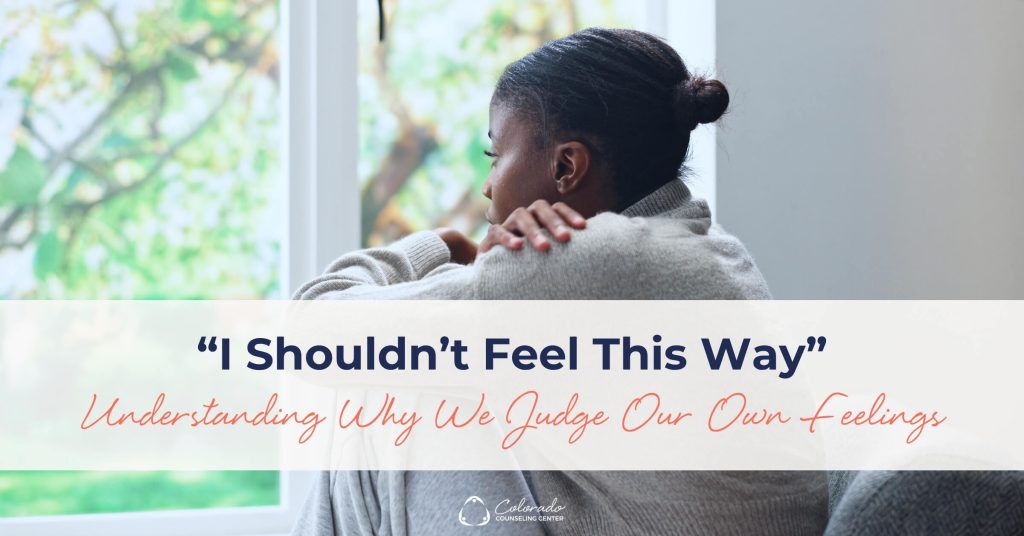
“I Shouldn’t Feel This Way”: Understanding Why We Judge Our Own Emotions

Woman resting her hand on her own shoulder, quietly processing the thought 'I shouldn't feel this way'

“I shouldn’t feel this way.” Maybe this thought showed up in the middle of an ordinary day—driving home, on your lunch break, sitting across from someone you love. A feeling arrived, uninvited, and right behind it came the judgment: I shouldn’t feel this way.

It’s one of the most common thoughts people carry, and one of the most rarely questioned. We tend to treat it as fact rather than opinion—as though our feelings are supposed to follow some internal rulebook, and when they don’t, something has gone wrong with us. But “I shouldn’t feel this way” isn’t really a statement about your emotions at all. It’s a judgment about whether you’re allowed to have them. It can also be a judgment about what these feelings say about you.

Before we can understand why that judgment shows up so quickly, it helps to look at where it usually comes from.

Continue reading