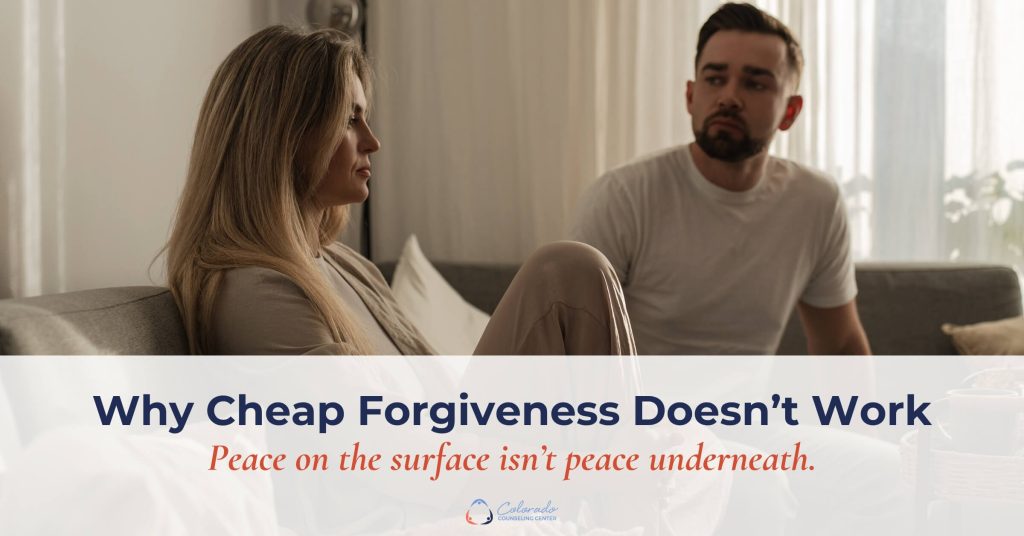
Cheap forgiveness looks like healing. It sounds like healing. Someone says “I forgive you,” the tension eases — at least on the surface — and everyone seems to move on. But underneath, nothing has changed. That gap between what’s said and what’s real is where the damage lives.
Clinical psychologist Janis Abrahms Spring, in her book How Can I Forgive You?, identifies cheap forgiveness as one of the ways we try to address hurt without resolving it: a quick pardon granted without coming to terms with the injury. It’s the first of several forgiveness patterns worth understanding — including refusing to forgive at all, healing when there’s no apology, and the kind of genuine forgiveness that repairs a relationship.
(Prefer to watch instead of read? The video below covers the same ground.)
What is Cheap Forgiveness?
Cheap forgiveness is a pardon granted before the work happens, before there’s any honest reckoning with what was done, or how it came to happen in the first place. The words are said. The apology, if there was one, gets accepted. But nothing underneath shifts: no remorse, no empathy for what the hurt cost, no understanding of what needs to change — and so nothing does.
That’s what makes it cheap: not that the forgiveness itself is insincere in the moment, but that it skips the part that would have made it durable.
Not every quick “it’s okay” is cheap forgiveness. Letting a small, low-stakes moment go without much discussion is often just proportionate. Cheap forgiveness is what happens when that same quick pass gets applied to something that called for more. The line between the two isn’t always obvious in the moment, especially if minimizing hurt has quietly become a habit for either person.
Why Do People Forgive Too Quickly?
Cheap forgiveness doesn’t come from bad intentions. Most people who grant it are trying, in their own way, to protect the relationship. It just doesn’t work the way they hope. A few patterns tend to be behind it:
Conflict avoidance. Most of us don’t enjoy conflict, so “let’s just move on” can feel like the kinder, easier path. For small friction points, that might be true. But for anything that cut deep, the relationship needs more than a quick pardon to recover. Skipping the harder conversation leaves the hurt buried.
Passive-aggressive patterns. This happens when the words “I forgive you” get said and the hurt stays, unspoken. The other person keeps paying for it in smaller, indirect ways: a cooler tone, a withheld closeness, a resentment that surfaces sideways. Nothing gets addressed, so nothing gets resolved.
Coercion and confusion. In relationships where a partner is dealing with addiction or is emotionally abusive, cheap forgiveness can come from somewhere much harder: being made to doubt your own experience. The person causing harm may insist nothing’s wrong, or that the problem is being blown out of proportion. Over time, this can leave the person being hurt uncertain whether their pain is even legitimate, which makes cheap forgiveness less of a choice and more of a survival response. If that sounds familiar, individual counseling for relationship issues can help you start trusting your own perception again, even before the relationship itself changes.
If you’re afraid of your partner or don’t feel safe at home, the National Domestic Violence Hotline is available 24/7 at 1-800-799-7233, or by text (text START to 88788). If you’re in immediate danger, call 911.
A history of feeling unworthy. Sometimes cheap forgiveness reaches back further than the relationship it’s happening in. When someone has spent years — growing up, or in earlier relationships — feeling unseen, unwanted, or misunderstood by the people who were supposed to matter most, it’s easy to absorb the belief that this is simply what they deserve. They may want something different without quite believing they’re allowed to ask for it. So when the hurt happens again, forgiveness comes fast, because expecting better has never felt like an option.
The Cost of Cheap Forgiveness
Whatever the source, cheap forgiveness doesn’t hold up over time. Safety, growth, and healing can’t be built on it. It comes at a cost, one that’s easy to miss at first because on the surface, things look calm.
Cheap forgiveness is a little like sweeping broken glass under a rug. The mess is out of sight, but the sharp edges are still there — and everyone keeps walking on them. The cuts keep happening. Each time, the hurt goes unresolved and gets swept back under, and the relationship stays where it was.
In the short term, cheap forgiveness can feel like the easier option, the path of least resistance. But over time it takes a toll in familiar ways: quiet resentment, distance, and distrust that build without an outlet; a slow erosion of self-worth, where the person who keeps forgiving too easily starts to wonder if they’re even allowed to expect better.
A Counterfeit of Mercy
Cheap forgiveness can look like mercy. It isn’t.
It isn’t merciful to the person who caused harm, because it asks nothing of them: no accountability, no reckoning with what they did. That leaves them no chance to become more thoughtful, more responsible, more capable of caring well for the people close to them.
It fails the person granting it, too. Real mercy requires truth first. Without an honest look at what happened, why, and what it did to the other person and the relationship, there’s no path toward understanding, change, or healing. What’s left is an agreement to stop talking about it.
Cheap forgiveness might feel like the compassionate choice in the moment. But compassion that skips the truth isn’t compassion. It’s counterfeit forgiveness — one that costs both people more than it ever saves.
Does any of this ring true in your relationships?
If you’ve found yourself granting cheap forgiveness, or you’re on the receiving end of it and the relationship still hasn’t healed, individual counseling for relationship problems and couples counseling can help you work through it. We’re here if you’d like support, and a free 15-minute consultation is also available.
Common Questions about Cheap Forgiveness
By Paul Sigafus, LMFT
Originally published October 17, 2019 · Updated October 13, 2026