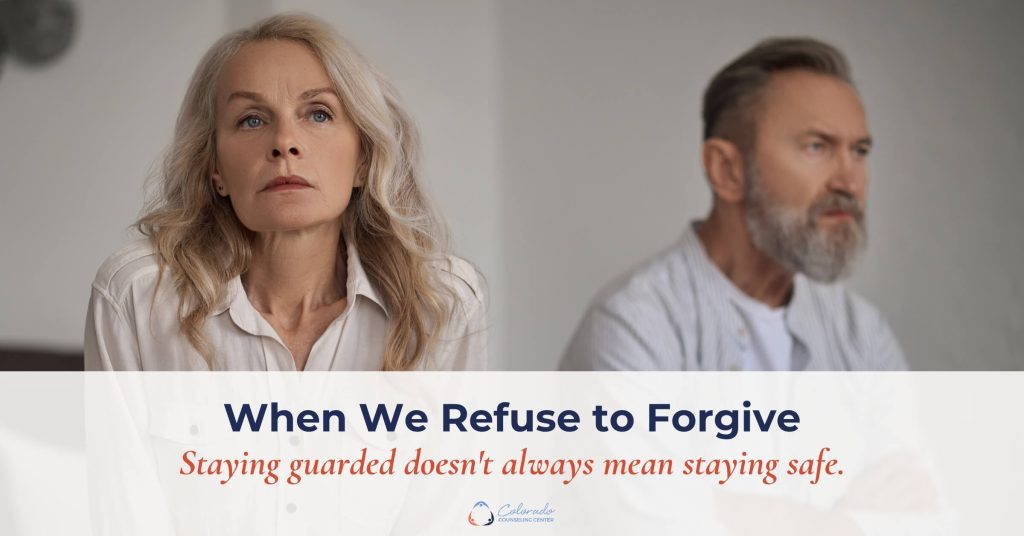
Some hurts don’t get forgiven quickly — and some don’t get forgiven at all. Not because the person holding onto them is stubborn or cold, but because staying guarded has, at some point, felt like the only way to stay safe.
Janis Abrahms Spring, in her book How Can I Forgive You?, calls this refusing to forgive. It sits at the opposite end of the spectrum from cheap forgiveness, where people let something go before they’ve reckoned with it. Refusing to forgive is what happens when someone never lets go at all. The bitterness, the anger, the distance — they become the way the relationship stays.
It’s an understandable response. It’s also a costly one.
Prefer to watch? Here’s the video version of this post, from several years ago.
What Is Refusing to Forgive?
Refusing to forgive means holding on to hurt, anger, and resentment rather than working through them — the second of the two incomplete responses Spring identifies.
It’s Natural to Be Cautious After Betrayal
Wariness after being hurt isn’t the problem. It’s often wisdom.
Many people who’ve been hurt feel pressure — from the other person, from well-meaning friends, from their own impatience — to grant forgiveness quickly. That pressure can push someone into cheap forgiveness: saying the words before the reckoning has happened.
Taking time to understand what happened, and what moving forward safely would require, isn’t refusal. The harder work belongs to the offending party: looking honestly at themselves, owning what they did, and changing the behavior that caused the harm. Caution during that process is appropriate. This post is about what comes after: the accountability has happened, real change is visible, and the guardedness still doesn’t lift.
Why Do People Refuse to Forgive?
Refusing to forgive rarely comes from just one place.
A History of Unsafe Relationships
Some people learn early, and repeatedly, that trusting others isn’t safe. Growing up around deceit, self-centeredness, neglect, or abuse teaches a lesson that outlasts any one relationship: other people can’t be relied on to treat you well, so it’s on you to stay alert.
That lesson travels into other relationships, including ones that don’t repeat the original harm. Vigilance starts to feel like the only form of protection that’s ever worked. Relaxing it, even with someone who’s genuinely trying, can feel dangerous.
Refusing to forgive, in this case, isn’t solely about the person in front of you. It’s a strategy that was built somewhere else, for someone else, and hasn’t been updated since.
Lack of Sincere Remorse & Change
Healing happens best when the person who caused harm meets it with remorse: an apology backed by visible, sustained change in behavior. When that doesn’t happen, staying guarded is a reasonable read of the evidence.
Without that experience, it’s easy to land on a conclusion that feels less like pessimism and more like self-protection: people don’t change.” If nothing has shifted, why should we trust?
The harder question is what happens when change does come — slowly, imperfectly, but sincerely. That’s often where refusing to forgive stops being a response to the evidence and starts being something else.
Black-and-White Thinking as Self-Protection
For some people, refusing to forgive isn’t about the offense itself. It’s about what looking any closer might require of us. If we examine our own part in a relational pattern, even a small one, it can start to feel like we’re excusing what was done to us, or agreeing that it mattered less than it did. So the pain gets held onto in its most condensed, one-sided form: what happened to me, done by them, full stop. Nothing shared, nothing complicated, nothing to look at on our side of it.
This usually happens without a conscious decision, as a way of protecting the clarity of our own hurt. Once the picture gets more complicated, it can feel like we’re losing our footing, or losing our case.
Examining our own part in a relational pattern doesn’t excuse harm or make it smaller. That kind of self-examination isn’t the right move in relationships marked by abuse or one-sided betrayal, where insisting that the victim look inward is wrong entirely. It applies to the everyday friction of an otherwise healthy relationship, where black-and-white thinking can quietly become its own form of self-protection, holding a stance of “all their fault, none of mine” long after that stance stops reflecting what’s true.
Why It Can Feel Automatic
Whatever the origin — an unsafe history, a lack of sincere remorse, or the self-protection of black-and-white thinking — the nervous system is built to keep us safe, and sometimes it does that by writing an implicit rule and running on it without our consent or awareness:
Never forgive. Never forget. Never trust. Always be on your guard.
That rule feels like instinct, the same instinct that makes us flinch at a sound that once meant danger, long after the danger has passed. Refusing to forgive can operate this way: the body settles into guardedness and hasn’t yet been convinced it’s safe to leave.
The Cost of Refusing to Forgive
A body that stays on guard doesn’t get to rest. Many people who hold on to a hurt feel it physically: a readiness that never quite switches off, a tension or dissatisfaction that’s hard to trace to any one cause. The body can respond to a remembered hurt the way it would to a present one.
Refusing to forgive costs the relationship, too — if there’s still a relationship to speak of. It can feel like protection, but it’s a cold one. It isolates us from the person who hurt us, often from other people as well, and from the best possibilities available within ourselves: the capacity to trust again, to be surprised by someone, to let a relationship become something other than what it was at its worst moment.
And sometimes, once the other person has owned what they did, refusing to forgive isn’t just pain that hasn’t resolved — it’s punishment that hasn’t stopped. Staying stuck in refusal can become a way of avoiding a difficult decision: whether to do the work of rebuilding, or to leave. Instead, the relationship gets suspended in between, never repaired, never released, while the other person serves an open-ended sentence. It’s a kind of captivity for both parties.
Refusing to forgive rarely protects the future the way it feels like it will. It protects the past, at the expense of what could still be built.
We Need Better Options for Forgiveness
Cheap forgiveness and refusing to forgive sit at opposite ends of the same problem. One skips the reckoning. The other never reaches it.
What we need instead are options that hold safety, dignity, and accountability at once, without demanding we pretend the hurt didn’t happen or stay permanently guarded against a future that might look different from the past.
Sometimes that looks like acceptance: finding peace and moving forward even when the other person hasn’t done their part, or isn’t available to. Other times, when heartfelt accountability and change are present, it looks like true forgiveness — not the quick, cheap kind, but the kind that’s earned — and granted.
Still keeping your guard up, though part of you wants to let it down?
If the guard you put up back then hasn’t come down since, individual counseling focused on relationship dynamics can help you understand what’s underneath the refusal. It can also help you find a way through, without talking you out of your pain. For many people, that work is what makes couples counseling possible later, once the pattern that’s been running the show has some room to loosen. If you’d like to see whether we’re the right fit, a free 15-minute consultation is available. You can also schedule an appointment directly below.
Common Questions About Refusing to Forgive
By Paul Sigafus, LMFT
Originally published October 21, 2019 · Updated October 14, 2026