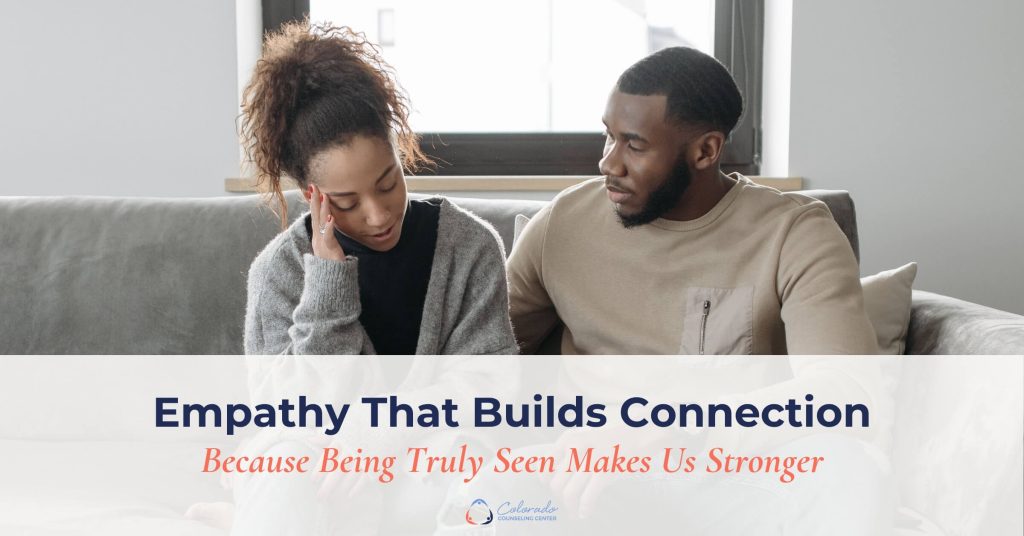
A couple sits across from each other, and one of them finally shares something true and vulnerable: “I’ve felt so alone in this.” There are two ways the moment can go. One partner can respond with a fix — a plan, a defense, a reason it’s not that bad. Or they can sit still long enough to actually feel what their partner is feeling, and let that show on their face before they say anything at all.
Only one of those responses tends to bring people closer.
It’s easiest to notice empathy — and its absence — around pain or fear. But empathy is just as needed in response to overwhelm, uncertainty, and loss — and even hope or excitement. Whatever the emotion, the same thing is happening underneath: one person letting themselves feel, for a moment, what another person is already feeling.
That’s what actually builds connection. And it’s something every one of us can get better at — not by learning a new skill, but by getting a little braver about staying present with what someone else is going through. That kind of bravery is really what vulnerability is — often the harder half of empathy that doesn’t get talked about as much.
What Does Empathy Actually Look Like?
Researcher Theresa Wiseman spent years studying what separates people who empathize well from people who don’t, across nursing, teaching, and counseling. What she found wasn’t a technique — it was a way of being with someone. Seeing things from their point of view, even if you wouldn’t feel the same way yourself. Staying out of judgment about how they’re handling it. Actually recognizing what they’re feeling, not just what happened to them. And finding some way — a look, a few words, just staying present — to let them know you’re with them in it.
That’s different from sympathy, even though the two get confused constantly. Sympathy looks down at someone’s situation and feels bad for them. Empathy climbs down into it. A friend who says “at least it’s not worse” is offering sympathy. A friend who goes quiet, leans in, and says “that sounds really hard” is offering empathy — and it almost always lands better, even though it says less.
Brené Brown, who’s done some of the most widely known work on this distinction, put it simply: “What makes something better is connection.”
You don’t need a clinical background to practice this. A parent sitting with a child who’s upset — not rushing to fix it, not minimizing it, just staying close while the child feels what they feel — is doing the same thing a partner does when they set aside their own defensiveness to really hear what their spouse is going through. The context changes. The underlying move doesn’t.
How Do You Show Empathy in Everyday Life?
Showing empathy isn’t a formula you apply the same way every time — it looks different depending on who’s in front of you and what they need in that moment. Getting curious is a good start: setting aside whatever you were about to say, and asking yourself what this is actually like for them right now. But empathy asks more of us than curiosity alone. It’s not just understanding someone’s situation intellectually — it’s letting their emotional experience resonate with something inside us that already knows that feeling.
Physician and writer Rachel Naomi Remen once watched Carl Rogers, the psychologist whose work laid the foundation for how we understand empathy in therapy, demonstrate this in front of a room of colleagues. Before beginning, he paused and said simply that there was no experience, fear, or suffering in the person across from him that he couldn’t recognize in himself, simply by virtue of being human too. Because of that shared humanity, he said, whatever someone was going through, they no longer needed to be alone with it.
Empathy’s real function isn’t to fix what someone feels — it’s to make sure they don’t have to feel it in isolation.
That felt sense is what people are actually responding to, more than any particular thing we say. With a partner, it might mean letting what they just said actually land — really taking in what they’re feeling before your own reaction starts forming a response. With a friend, it might mean letting their story actually move something in you before you respond, rather than reaching straight for “that happened to me too.” With a coworker, it might be pausing long enough to actually feel the frustration behind their words before offering a solution they didn’t ask for. And when someone you love comes to you lit up about something good, it might simply mean letting their excitement move you too, instead of half-listening while you wait for your turn to talk.
None of this requires getting it perfectly right. What people can sense — and what actually helps — isn’t precision. It’s whether we let ourselves be moved by what they’re going through, even a little, instead of staying safely outside of it.
But being moved is only the beginning. That felt sense has to travel somewhere — into a few honest words, a hand on a shoulder, or sincere care expressed through our gaze during a difficult moment. Sometimes the most honest words are the simplest ones: “I can feel the heaviness of what you’re carrying,” or “when you said that, my stomach dropped.” Naming what happened in us as we listened tells someone their experience didn’t just reach our ears — it reached something in us that responded in kind.
Why Doesn’t My Partner Understand How I Feel?
Sometimes you try to explain how you’re feeling and it just doesn’t seem to land. Instead of feeling seen and understood, you’re met instead with defensiveness, a fix you didn’t ask for, or a blank look that makes you feel even more alone.
This rarely means your partner doesn’t care. More often, it means they’re too flooded by their own reaction to get anywhere near yours. A partner who feels criticized, blamed, or like they’re failing you can get so overwhelmed by that feeling that there’s no room left to take in what you’re actually saying. They’re not choosing to withhold empathy — they’re stuck outside it, caught up in protecting themselves from a threat that, to them, feels just as real as what you’re carrying.
That distinction matters, because it changes what actually helps. Waiting for someone to simply try harder rarely works if what’s in the way isn’t effort — it’s their own nervous system getting in the way of yours. This is a lot of what Emotionally Focused Therapy works to address: helping each partner recognize when they’ve gone from feeling with someone to defending against them, and finding a way back to each other before that gap turns into distance that’s harder to close.
If this is a pattern in your relationship — not a single hard moment, but something that keeps happening — it’s worth taking seriously. It’s not a sign that empathy is impossible between you. It’s usually a sign of what’s getting in its way.
What Happens When Empathy Arrives
Picture that couple again — one of them just shared something true and vulnerable: “I’ve felt so alone in this.” Now imagine the other response. Their partner doesn’t reach for a fix. They don’t explain why it’s not that bad. They let themselves feel the weight of what their partner just said, and something in their own face shifts, because what they just heard actually reached them. Maybe they say something small and honest — “I can feel how lonely that’s been for you.” Maybe they just reach for a hand.
Nothing about the situation has changed. The stress is still there. The hard week, the fear, the loss — whatever it was — hasn’t been solved. But something else has: for a moment, it isn’t being carried alone.
That’s what empathy actually does. It doesn’t fix. It accompanies. And it turns out that’s often the thing that was needed most — not a solution, but someone willing to feel it alongside us. That’s how empathy builds connection: not all at once, but in moments like this one, over and over, until being truly seen by each other starts to feel less like the exception and more like how you get through things — together.
Ready to Build This Kind of Connection?
If you’ve felt what it’s like to reach for empathy and come up short, or to long for it from someone who can’t quite get there right now — you don’t have to figure it out alone. Whether it’s in your relationship, your family, or in how you relate to yourself, learning to offer and receive real empathy is something we help people build every day, together with the people who matter most to them.
Colorado Counseling Center offers in-person counseling in Greenwood Village, just minutes from Centennial and Lone Tree, plus online therapy throughout Colorado.
For more on what steady, connected relationships actually look like day to day, see 10 Practices of Happy Couples.
Frequently Asked Questions About Empathy in Relationships
By Paul Sigafus, LMFT · August 10, 2026
Substantially updated from original 2014 post by Kevin Hales, LPC