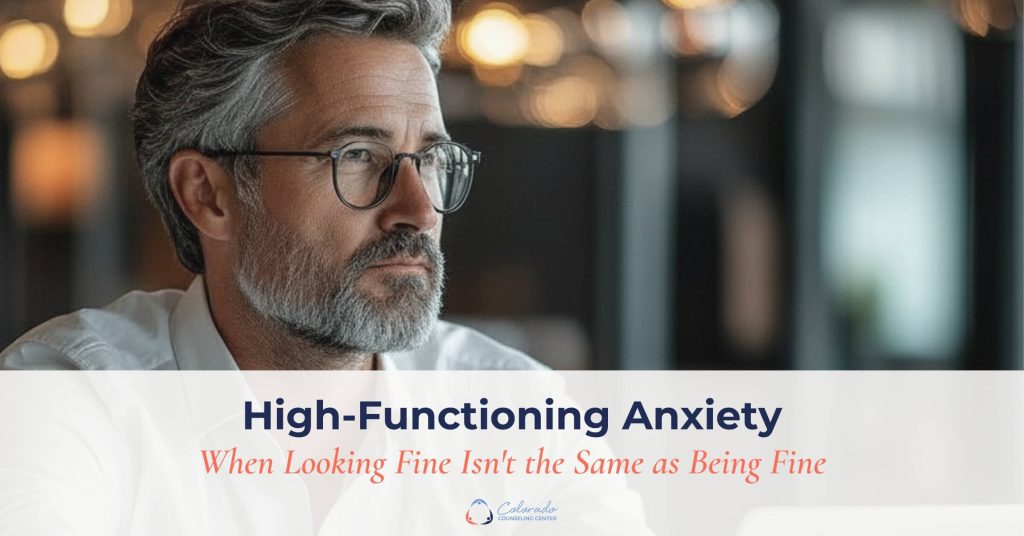
What parades as perfectionism often has deep roots in fear and anxiety — though most people wouldn’t describe it that way until something breaks.
Maybe that’s true for you at work. Maybe it shows up instead in how you run a household, raise your kids, show up for a creative practice, or carry yourself through school. High-functioning anxiety doesn’t only wear a blazer. It can look like any life where nothing is allowed to fall apart or be less than exceptional.
From the outside, you look like someone who has it together. You meet deadlines before anyone has to ask. You’re the one people call when something needs to get done right. Your calendar is full, your standards are high, and by most measures, you’re doing well.
But something else is happening underneath. Your mind doesn’t quiet down when the day ends. Rest feels harder to access than it should. There’s a low hum of tension that follows you even after your tasks are finished. Relief doesn’t quite arrive — there’s just the next thing waiting.
This is what high-functioning anxiety often looks like: not visible distress, but a kind of constant motion that gets mistaken — by others, and often by the person living it — for drive and success.
What High-Functioning Anxiety Actually Is
High-functioning anxiety isn’t an official clinical diagnosis — you won’t find it listed in a psychology manual. It’s a term that’s grown out of a very real, very common experience: anxiety dressed up in the guise of competence.
Instead of falling behind, you stay ahead. Instead of struggling to function, you regularly perform well in your roles and responsibilities —sometimes even drifting into overfunctioning to make up for the marginal efforts of others around you. The anxiety rarely shows up as visible panic or paralysis. It shows up as motion. As competence and high standards. It shows up as the instinct to double-check, to over-prepare, and to keep going longer than you probably need to.
This doesn’t make the anxiety less real. It just makes it easier to miss — by the people around you, and often by you, too.
How High-Functioning Anxiety Hides Behind Achievement
This pattern doesn’t start the same way for everyone. For some, it’s built from years of praise and reward. For others, it’s built from criticism, high expectations, or never quite measuring up — and achievement becomes the way to finally prove they’re enough. Different starting points, same destination: worth that feels conditional on performance.
How the Pattern Gains Momentum
Capacity gets praised. Intelligence gets praised. Focus, drive, ambition, creativity — all of it gets reinforced and rewarded. Nobody intervenes on a strength. Nobody sits you down and asks if you’re okay, because everything about you looks like the opposite of a problem.
This reinforcement rarely stops at the individual level. Workplaces, families, and academic environments often set the bar high enough that excelling stops being optional and starts being the baseline expectation. A culture that runs on hustle and grind, or a family where achievement has always been how love and approval got expressed, can make “doing more” feel less like a choice and more like a never-ending cost of continued worthiness and belonging.
There’s also a broader cultural story at play — a long-standing American narrative that ties hard work directly to worth and character — and it’s woven into workplaces and families widely enough that it can shape your standards long before you’d think to question where they came from. None of this makes a strong work ethic the problem; wanting to do good work and take real pride in it is worth protecting. The issue is what happens when that work ethic stops being a choice.
Over time, the traits associated with success can unintentionally become something else: not just things you’re good at, but the requirements for being okay. Worth, success, even basic well-being start to feel conditional on staying capable, staying ahead, staying on top of things — whether that’s at work, at home, or in how you show up for the people who depend on you. “Doing well” comes to mean nothing ever gets dropped.
And when exhaustion or burnout finally arrives, the belief system already in place doesn’t let it register as a signal for you to slow down — it gets read as laziness, as not trying hard enough, or even as failure. The inner critic that’s been driving the pattern all along continues to call the shots, exactly when the opposite is needed.
Chasing a Safety That Never Quite Arrives
Part of what keeps this going is a kind of bargain: if I get this right, if they’re pleased, if I stay ahead of it — then I’ll finally feel okay. But that safety never quite arrives, because the anxiety was never really about the outcome. Your nervous system doesn’t calm down when your goal gets met; it just moves on to the next one. It’s learned to continually scan for danger, as clinician Alan Gordon describes it — and achievement becomes one more way of trying to create safety by outrunning perceived threats.
Author Matt Haig writes about this mismatch in Life on a Nervous Planet — the gap between how we’re built and the pace we’re expected to keep in modern life. High-functioning anxiety often lives in exactly that gap.
When the Standard of High-Functioning Anxiety Turns Outward
This pattern doesn’t always stay contained to you alone. When something feels out of your control — a project that’s gone shaky, uncertainty about what’s coming next, private doubt about your own performance — that discomfort often looks for somewhere else to go.
It can show up as becoming a little more intrusive in your teenager’s life, a little more overinvolved in your partner’s choices, a little quicker to critique. Overfunctioning in one area becomes a way of compensating for a lack of certainty in another. You’re probably not doing this consciously, and it rarely gets framed, even privately, as “I can’t manage this uncertainty, so I’ll manage you instead.” It often comes from genuinely wanting the people you care about to do well, to succeed, to be spared struggle.
But when someone else feels like they’re constantly falling short of an invisible bar, that has a real cost on the relationship, whatever your intention was. This can become an intergenerational pattern, too, especially in families where achievement has always been the currency of approval — passed down not necessarily as explicit instructions, but as atmosphere and unspoken expectations.
High standards aren’t the problem. Wanting to do well, and wanting the people you love to do well, isn’t the problem. What matters is where the standard is coming from — and whether there’s room to fall short of it without something breaking.
Why High-Functioning Anxiety Is So Often Missed
Anxiety, as most people picture it, looks like struggle. Someone falling behind, someone visibly overwhelmed, someone who can’t get out of bed or through the day. That picture makes it easier to notice and respond to.
High-functioning anxiety looks different. It looks like the person everyone relies on — the same competence and readiness I described earlier. Because those traits are the ones getting praised and rewarded, not questioned, there’s rarely an external warning that anything is wrong. Nobody around you is asking if you’re okay, because you seem like you have it all together.
That absence of an outside warning signal sometimes means there’s no inside one either, at least not one you listen to. Your mind, constantly scanning ahead, staying prepared, staying one step in front of things, doesn’t register its own exhaustion as information — it registers it as one more thing to push through. Your nervous system becomes ever more skilled at detecting danger, to the point that ordinary sensations and normal setbacks start to feel urgent even when nothing is actually wrong. A stumble at work becomes evidence of failure. A quiet moment becomes something to fill. The alarm doesn’t wait for a real emergency; it treats everyday life like one.
This is what hypervigilance looks like when it never gets to stand down.
This is part of why you can be doing everything ‘right’ and still feel a version of, why do I feel anxious when everything is fine? Nothing on the outside is broadcasting danger. But your internal system hasn’t gotten that message yet — and until it does, competence keeps covering for a kind of exhaustion that never quite gets named.
What High-Functioning Anxiety Can Look Like Day to Day
The signs are often easy to miss precisely because they don’t look like signs — they look like personality, or diligence, or just “how you are.”
Rest doesn’t come easily, even when there’s time for it. A free evening or a slow weekend can feel harder to sit in than a full schedule. Stillness leaves too much room, and the mind fills it with what’s next instead.
Preparation stretches past what the situation actually calls for. Re-reading an email five times before sending it. Running through a conversation in your head long before it happens. Packing for every contingency, even ones that are unlikely. It’s not that any one instance looks unreasonable — it’s the constant baseline of more than what’s needed, a form of perfectionism.
Even finished work doesn’t always feel finished. You have the conversation, close the laptop, send the email, or wrap up the project — but the sense of completion you were expecting doesn’t quite show up. There’s a nagging pull toward it could have been better even when there’s no real evidence anything was wrong with it. The task ends. The feeling that it’s done doesn’t always follow.
Falling behind feels dangerous, even when nothing is really at stake. A missed reply, an unread message, a task left undone overnight — these can carry a weight that’s out of proportion to their actual consequences, as though not staying on top of things will lead somewhere much worse.
Slowing down invites self-criticism instead of relief. An unpressured day with an open schedule can prompt I should be doing something rather than rest. Productivity becomes the resting state, and anything short of it starts to feel like a small failure.
Physically, it often doesn’t look like panic. It looks like a jaw that stays tight, a mind that’s already three steps ahead during a conversation, a body that’s technically still but never quite settled. Sleep can be shallow or delayed, not because of one obvious worry, but because the system hasn’t gotten the signal that it’s safe to power down.
None of these, on their own, are unusual. Together, over time, they describe a nervous system that’s rarely had the chance to fully rest — even while everything on the surface looks like it’s going well.
What Actually Helps
If you recognize yourself in any of this, there’s a good chance your instinct is to solve it — read more, optimize your schedule, find the right framework, treat this the way you treat everything else that needs fixing.
That instinct makes sense. It’s the same inclination that’s carried you this far. But it’s also part of what keeps the pattern going, because it tries to manage the anxiety through more effort, when what the nervous system actually needs is something closer to the opposite: less urgency, less pressure, more room.
Healing this kind of anxiety doesn’t usually happen through pushing harder or turning yourself into another project to improve. It happens through safety — the felt sense, built over time, that things can be okay even when they’re not fully handled, not fully certain, not fully under control. That’s a hard thing to learn on your own, especially if uncertainty has always felt like something to fix rather than something to befriend. Learning to stay present with not-knowing, without needing to immediately resolve it, is its own kind of practice — one most people don’t build alone.
This is where therapy can offer something a self-directed approach usually can’t: a relationship steady enough to practice that safety in, with someone who isn’t asking you to do more, but helping you find out what it’s like to need to do a little less. Over time, that’s often what allows the achievement to stop being the only place where the anxiety gets to rest.
You’re Allowed to Need Less — and Enjoy More
If you’ve read this far and recognized pieces of yourself — the constant readiness, the discomfort in stillness, the sense that slowing down means falling behind — that recognition is worth something on its own. Most people carrying this pattern have never had it named. They’ve had it praised — even as it’s silently exacting a steep cost.
You don’t have to dismantle your ambition or stop caring about doing things well to find relief. What you’re looking for isn’t less capability. It’s permission to be a whole person even when you’re not performing at full capacity — to let something go undone, to rest without “earning” it first, to be uncertain about what’s next without needing to control it.
Underneath all of it, there’s something simple: you are allowed to have a life, not just occupy one. You’re allowed to experience beauty, moments of ease, and gentleness. You’re allowed to feel what you feel, without qualifying it or making a case for it. You can learn to say yes to living, and let go of the pressure to perform.
That kind of permission is hard to give yourself when you’ve spent a long time being the one who holds everything together. It’s something you’re allowed to build with support, not just figure out alone. And when you do, something tends to open up: not just easier relationships — with your kids, your partner, the people at work — but an easier relationship with your own life.
Enjoyment, presence, simply being — without something to show for it — are not less valuable than achievement.
They’re just as worthy.
You’re allowed to be human: incomplete, imperfect, and still worthy of ease.
You’re allowed to experience your life, not only accomplish it.
If this sounds familiar, our approach to anxiety therapy is built around exactly this — not managing symptoms from the outside, but helping you understand what’s been driving the pattern, and finding out what it feels like to need less in order to be okay. It’s a more sustainable and satisfying way to live.
If you’re ready to talk with someone, call or text us at (720) 468-0101 to schedule a free 15-minute consultation.