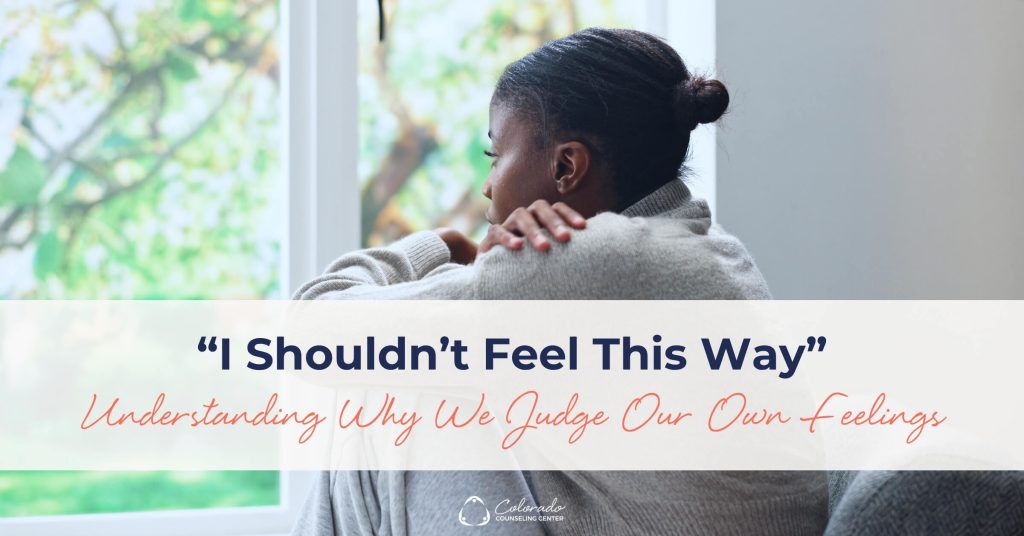
“I shouldn’t feel this way.” Maybe this thought showed up in the middle of an ordinary day—driving home, on your lunch break, sitting across from someone you love. A feeling arrived, uninvited, and right behind it came the judgment: I shouldn’t feel this way.
It’s one of the most common thoughts people carry, and one of the most rarely questioned. We tend to treat it as fact rather than opinion—as though our feelings are supposed to follow some internal rulebook, and when they don’t, something has gone wrong with us. But “I shouldn’t feel this way” isn’t really a statement about your emotions at all. It’s a judgment about whether you’re allowed to have them. It can also be a judgment about what these feelings say about you.
Before we can understand why that judgment shows up so quickly, it helps to look at where it usually comes from.
Why Do We Judge Our Emotions & Feelings?
If you’re like most people, the habit of judging your emotions didn’t start with a single moment—it was built slowly, over years. Maybe certain emotions weren’t welcome growing up. A parent grew uncomfortable with tears, or anger, or sadness that lingered too long—and the message, spoken or not, was clear: this feeling is too much. Maybe that message continued into adulthood—a partner, a friend, or a colleague treating your emotions as inconvenient, too much, or something that needs to be fixed.
Other times, the judgment doesn’t come from anyone else at all—it’s your own inner critic at work. Anger can seem to contradict the kind of person you want to be. Jealousy or envy can be embarrassing to even admit to yourself, let alone say out loud. Resentment toward someone you love can seem like evidence that you’re not as loving or grateful as you want to be. It’s common to feel guilty for emotions like these—as if having them at all is something to hide or suppress rather than something to simply experience. We imagine that just having them says something bad about us.
Sometimes, too, a feeling really does seem bigger than the moment that triggered it. A small comment lands hard. A minor setback brings tears that surprise even you. An inconvenience makes your anger flare. It’s tempting to treat that gap—between what happened and how big it feels—as proof that something is wrong with your reaction. But the size of a feeling isn’t a test you have to pass before you’re allowed to have it. The first step is letting yourself feel things without judgment, and staying curious about where the emotion—and its intensity—is coming from. That curiosity matters, because sometimes an intense reaction is telling you something real—that a particular place is more tender than you realized, every touch landing harder than it should. Getting compassionately curious about that intensity, without judging it, is often what opens the door to understanding it—and eventually, to it softening.
Sometimes what’s missing isn’t just an understanding of your own emotional experience—it’s never having been in a relationship where deep emotion felt safe. Without that, understanding your emotions can be difficult to develop at all; the safety and resilience needed to tolerate big feelings is something we learn in connection with someone else, not on our own. If you didn’t grow up with people who could stay calm, kind, and present with your emotions—or don’t have relationships like that now—it makes sense that big feelings can be hard to trust or tolerate. When we’re met with steady responses like that, we learn something important: that even intense emotion, uncomfortable as it can be, is rarely dangerous. This is often exactly what happens in individual therapy: a relationship where difficult feelings can be experienced, understood, and gradually made more tolerable. We shift from judging our emotions to living with them and learning from them.
Comparative Suffering: Ranking Our Pain Against Others’
There’s another, more subtle version of “I shouldn’t feel this way”—a sneaky way of judging our emotions that shows up when we start measuring our pain against someone else’s:
- “I feel neglected lately, but at least we’re not fighting like some couples do.”
- “I’m worried about my child, but at least they’re healthy.”
- “I don’t really like my job, but at least I’m employed.”
- “I’m still not over losing my mom, but at least I had more time with her than some people get.“
Researcher and author Brené Brown calls this pattern comparative suffering—the instinct to rank our pain on an invisible scale, and to dismiss whatever lands lower on it. Even pain and hurt aren’t immune to being measured and ranked against each other, Brown observes. When our struggle seems smaller than someone else’s, we don’t just minimize it—we start to believe it doesn’t count at all. And when we think that we shouldn’t be feeling a certain way, pain quietly turns into something else: shame. Shame doesn’t just sit alongside a difficult feeling—it consumes it, turning something we could learn from into something we’d rather hide.
The comparison itself is the problem, not the size of what we’re comparing. Someone else’s suffering being real doesn’t make yours less real. It just means you’re both carrying something.
That’s especially true in grief, where the pressure to have “moved on” by now can turn missing someone into one more thing to feel guilty about. We go deeper into that particular version of comparative suffering in our post Who Am I Now? Understanding Grief and Identity Loss.
Compassion for Ourselves and Our Emotions
Is it possible to acknowledge our own pain without needing to rank it against anyone else’s? To let our problems be real, even when they aren’t the biggest problems in the world? And what about the feelings we’d simply rather not have at all—the anger, the jealousy, the resentment? Or the ones that make us feel exposed—the fear, the uncertainty, the sadness we’d rather not admit to? Can those be allowed too, even when they tell us things about our experience we’d rather not pay attention to?
Compassion works differently than the comparison and self-rejection we’ve been taught. It isn’t a limited resource that runs out when too many people need it—there’s no version of care where making room for yourself means taking it away from someone else. And it isn’t conditional on the feeling being flattering or comfortable. Turning toward your own pain, even the parts of it you don’t like, doesn’t diminish anyone else’s, and it doesn’t make you a worse version of yourself. If anything, the opposite is true: people who can hold their own struggle—including the feelings they wish they didn’t have—with compassion tend to have more room to hold others’, not less.
This is the same territory we explore in our post Why Do I Feel Like Something Is Wrong With Me?—the sense that certain feelings mean something is broken in us, rather than simply being part of being human. Comparative suffering, the wish to not feel what we feel, and that deeper judgement that “something’s wrong with me” often travel together, each one reinforcing the others. It’s also close to what we explore in our post on high-functioning anxiety — the sense that rest and ease have to be earned before they’re allowed, rather than simply available.
Feelings aren’t only things to make peace with—they carry information. We don’t have to judge our emotions; we can learn from them. Anger can point to a boundary that’s been crossed. Sadness can point to something worth grieving. Psychologist Ronald Frederick writes about this in his book Living Like You Mean It—the idea that our emotions, even the ones we’d rather not have, often know something about what we need before we consciously do. Judging a feeling too quickly doesn’t just create shame; it can drown out something useful the emotion was trying to tell you.
There’s a fear that often sits underneath “I shouldn’t feel this way”—the sense that if you let a difficult emotion in, it’ll take over and never leave. Grief expert David Kessler pushes back on this: emotions need motion. Emotions we actually allow ourselves to feel tend to move through us and change, rather than staying lodged in place forever. It’s often the resistance—not the emotion itself—that makes it seem unbearable and permanent.
Letting go of the emotional measuring stick—and the instinct to reject or suppress certain feelings outright—doesn’t happen all at once. But as it loosens, something shifts—we become kinder toward ourselves, and more genuinely present for the people around us. The “shoulds” quiet down. What’s left is more room to actually feel what you feel, without needing it to be an experience you approve of first. We can learn valuable things from our emotions, without being controlled by them. That kind of steady, compassionate space is exactly what individual counseling is for.
When You’re Ready, We’re Here
Schedule online, or call/text to schedule a free 15-minute consultation.
FAQ About Why You Feel This Way & How to Stop Judging Your Emotions
By Paul Sigafus, LMFT
Substantially revised from an earlier Colorado Counseling Center post.
Originally published March 30, 2017 · Updated July 29, 2026