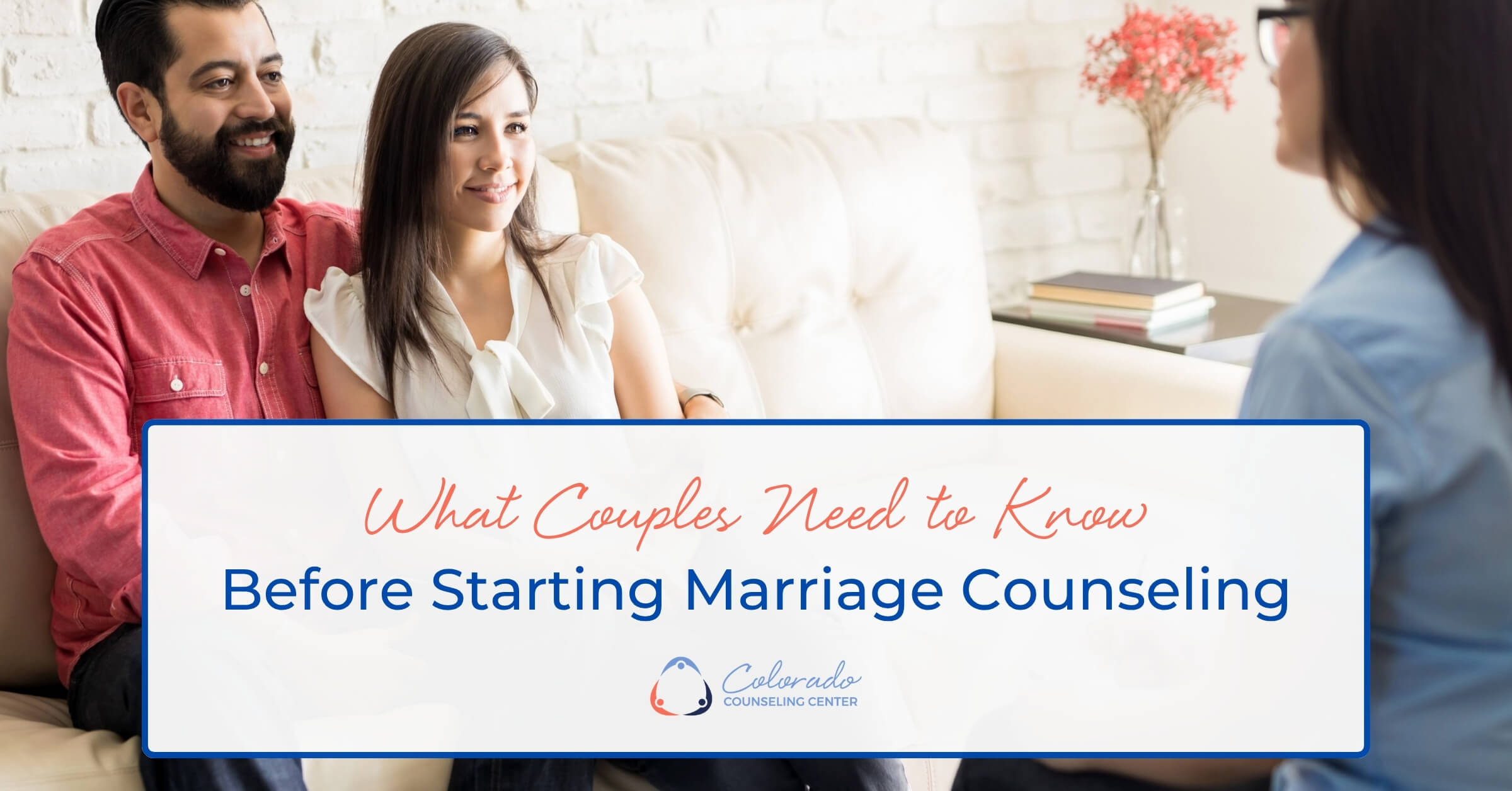
What Couples Need to Know Before Starting Marriage Counseling

Couple smiling and engaged during a marriage counseling session with their therapist

If you’re reading this, you’re probably carrying something heavy right now — a relationship that’s grown distant, conflicts that keep cycling back, or a quiet fear that things might not get better on their own. Maybe you’ve thought about marriage counseling before but weren’t sure where to start, or what to expect, or whether it would actually help.

Those questions are worth answering. And after more than 25 years of working with couples, I can tell you this: the couples who take time to understand the process before starting marriage counseling almost always enter with more hope, more realistic expectations, and a stronger foundation for the work ahead.

This marriage counseling guide is for you — whatever stage of readiness you’re in.

Continue reading
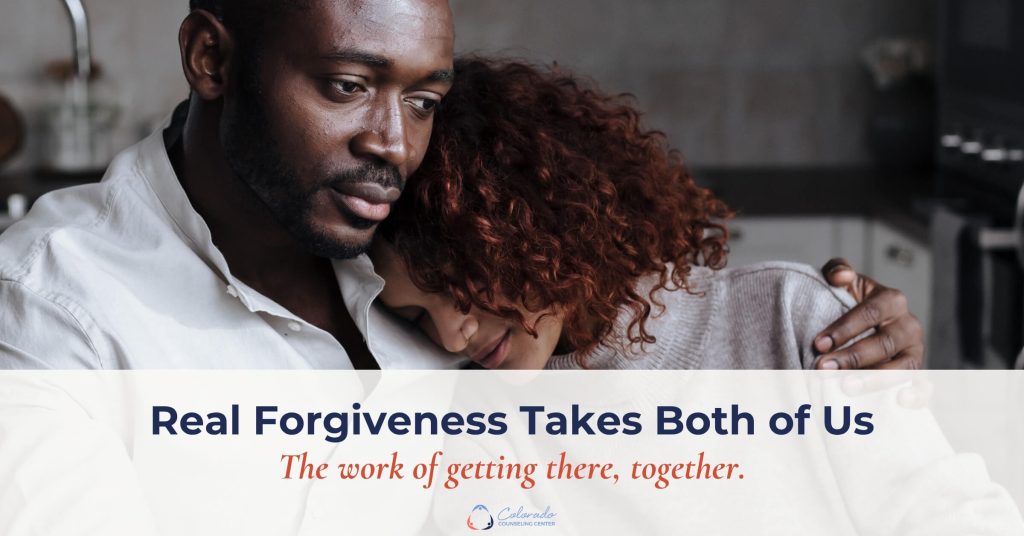
What True Forgiveness Actually Requires in Relationships

Man and woman embracing tenderly in a kitchen, working through true forgiveness together in their relationship

Some hurts don’t heal just because we decide to let them go. If you’ve read our posts on cheap forgiveness, on what happens when we refuse to forgive, or on finding acceptance when the other person isn’t sorry, you already know forgiveness isn’t one thing — it takes different shapes depending on what actually happened and what’s actually possible now.

This post is about the shape forgiveness takes when both people are still in the relationship, and both still willing to do the work. Not everyone has that option. Sometimes the person who hurt us is gone, or unwilling, or unsafe to stay close to — and in those cases, acceptance is often the best path available to us. But when both people are willing to do the work, something different becomes possible: what therapist and author Janis Abrahms-Spring calls genuine forgiveness, and what most of us are really asking about when we search for what true forgiveness actually looks like.

“Genuine forgiveness is essentially interpersonal. It requires the heartfelt participation of both of you,” Abrahms-Spring writes in How Can I Forgive You? We’ve watched this play out again and again in couples counseling: relational wounds heal best in a context where both people commit to the hard work of healing — however long it takes.

Continue reading

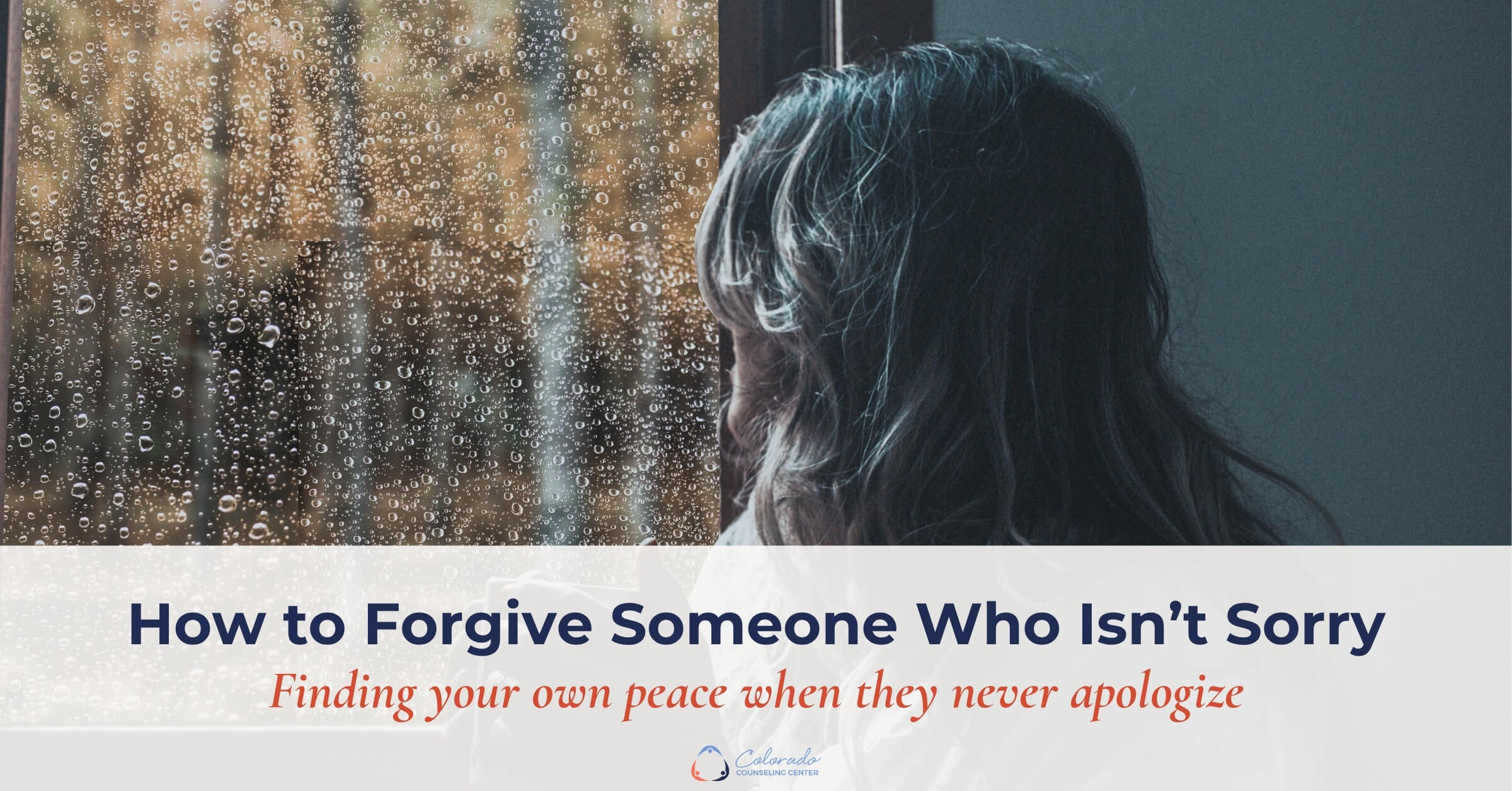
How to Forgive Someone Who Isn’t Sorry — Or Won’t Apologize

Woman sitting alone at a rain-streaked window, reflecting on forgiveness when someone isn't sorry

You’ve been waiting for an apology that isn’t coming.

Maybe it’s been months. Maybe years. You keep hoping this person will finally see what they did and say so — and instead, you get blame, silence, denial, or distance you can’t close because they’ve moved away, cut off contact, or simply aren’t capable of the kind of honesty repair requires. Sometimes there’s no path back to them at all — they’ve died, they’re in prison, or contact with them isn’t safe.

So you’re left holding all of it alone: the hurt, the anger, the constant replaying of what happened, and underneath that, a harder question — how do you forgive someone who isn’t sorry? How do you move forward when only one of you is willing to do any of the work?

Janis Abrahms-Spring, in her book How Can I Forgive You?, offers a name for exactly this situation: acceptance. It isn’t a consolation prize, and it isn’t giving up. It’s a different path than forgiveness as most people picture it — one that doesn’t require the other person to show up, apologize, or change at all.

This is what that path actually looks like, and how to walk it without waiting for something that may never come.

Continue reading

When We Refuse to Forgive

Older couple sitting apart with arms crossed, conveying emotional distance and refusal to forgive

Some hurts don’t get forgiven quickly—and some don’t get forgiven at all. Not because the person holding onto them is stubborn or cold, but because staying guarded has, at some point, felt like the only way to stay safe.

Janis Abrahms-Spring, in her book How Can I Forgive You?, names this refusing to forgive—the opposite end of the spectrum from cheap forgiveness, where people let something go before they’ve actually reckoned with it. Refusing to forgive is what happens when someone never lets go at all. The bitterness, the anger, the distance—they become the way the relationship stays.

It’s an understandable response. It’s also a costly one.

Continue reading

Why Cheap Forgiveness Doesn’t Work

Woman turned away in quiet tension while her partner watches with concern, illustrating the unresolved hurt beneath cheap forgiveness or counterfeit forgiveness

Cheap forgiveness looks like healing. It sounds like healing. Someone says “I forgive you,” the tension eases—at least on the surface—and everyone seems to move on. But underneath, nothing has actually changed—and that gap between what’s said and what’s real is where the damage lives.

Author Janis Abrahms-Spring, in her book How Can I Forgive You?, identifies cheap forgiveness as one of the ways we try to address hurt without actually resolving it: a quick pardon granted without coming to terms with what happened or how it happened in the first place. It’s the first of several forgiveness patterns worth understanding—including refusing to forgive at all, healing when there’s no apology, and the kind of genuine forgiveness that actually repairs a relationship.

Here, we’ll look at where cheap forgiveness comes from, why it doesn’t hold up over time, and what it costs the people caught in it.

Continue reading

Does Marriage Counseling Work? What to Know When You’re Afraid to Hope

Couple embracing on a beach at sunset with the title "Does Marriage Counseling Work? A Therapist's Honest Answer"

If you’re asking whether marriage counseling works, you’re probably not just looking for statistics.

You’re wondering whether it could work for you — for your relationship, with its specific history and particular weight. You may have already tried other things: long conversations that went nowhere, books that made sense in theory but not at midnight after another argument, a period of quiet truce that didn’t last. And somewhere underneath all of that is a question you might be afraid to ask too directly: Is it too late for us?

It isn’t a small thing to hope. When a relationship has been struggling for a while, hope itself can feel like a risk. So before you invest it, you want an honest answer.

Here’s ours — informed by decades of working with couples in therapy.

Continue reading

Why Do I Feel Like Something Is Wrong With Me?

Man standing alone under tree branches, looking out over a misty valley at sunrise — feeling like something is wrong with you

Why do I feel like something is wrong with me?

Maybe you’ve asked yourself that question — or its quieter cousin, is something wrong with me? — after a hard conversation, a mistake you can’t stop replaying, or a moment when you reacted in a way you didn’t recognize. Or maybe someone else asked it of you — “what’s wrong with you?” — and it’s stayed lodged somewhere you can’t quite shake.

If you’ve been sitting with the sense that something’s broken in you, or wondering why you feel this way when it seems like everyone else has it figured out, you’re not alone in asking. It’s one of the most common — and most painful — questions people carry into a therapy room. And it’s worth saying clearly, from the start: there is almost always a reason behind what we feel, say, and do, even when that reason isn’t obvious to us yet.

This is a conversation about shame — where it comes from, why it convinces us we’re fundamentally flawed rather than simply struggling, and what actually helps it loosen its grip.

Continue reading

Unlocking Love

Unlocking Love - Understanding Your Attachment Style
Originally published: September 14, 2018 | Updated: March 7, 2025

Attachment Styles: a Key to Understanding Your Relationships

Attachment is a buzz word you may have heard before, perhaps in Psych 101 class or mentioned in parenting books. But did you know that discovering what your and your partner’s attachment styles are can unlock the key to a greater understanding of your needs and theirs? Understanding your attachment style can be instrumental in unlocking love in your relationships.

Continue reading

Healing after Loss

Healing after Loss
Originally published: December 27, 2017 | Updated: March 7, 2025

Understanding the Impact of Loss

What do you do when the person you rely on for shelter in life is no longer there? How do you deal with the tsunami of emotions that come with a break-up, a divorce, a death? When that person is no longer there, we feel sadness, anger, hurt, fear—sometimes all at the same time. Healing after loss can be challenging. Sue Johnson, author of Love Sense and originator of Emotionally Focused Therapy (EFT) says that “we are wired for connection.” The anxiety and deep sadness we feel when we lose a loved one is not because we are “co-dependent” or “needy”, but because our partners matter to us. They impact our own need to feel accepted and loved. When a relationship ends, it is a loss. We are suddenly alone.

The Journey of Healing After Loss

Continue reading

Effective Apologies

Effective Apologies

Saying sorry is not that hard. Not when you’re pulling out your carry-on from the overhead compartment and you bump that unsuspecting passenger. Or when your colleague has been waiting for that email from you since yesterday morning. Not even when you’ve just cut off someone because you were in a hurry and they make sure to let their horn tell you how they feel.

But when it comes to those who live and interact with us more intimately, apologizing is one of the hardest things to do, much less do effectively. There is a price to letting others into the limited confines of our heart space—we will bump into each other. Given the inevitably of these collisions, I’d like to speak to a few principles outlined by Harriet Lerner, PhD, that can help in making effective apologies. The following principles are taken from her interview with Brene Brown. Continue reading