Quieting the Inner Critic

Open journal and pen beside a cup of coffee in warm morning light, representing a gentle, reflective approach to quieting your inner critic

If you’ve ever caught yourself thinking “I’m so lazy,” “I always mess this up,” or “What’s wrong with me?” — you already know the voice we’re talking about. Quieting your inner critic starts with understanding something most of us get backwards: that harsh, relentless voice in your head isn’t there to hurt you. It’s trying to protect you.

That distinction matters. When we treat the inner critic as an enemy to defeat, we end up in a battle with ourselves — and battles with ourselves are exhausting, and rarely winnable. But when we understand what the critic is actually trying to do, we can respond to it differently. Not by silencing it through force, but by meeting it with the kind of steady, compassionate attention that actually helps it soften.

This is true whether your inner critic shows up as everyday self-doubt, the nagging sense that you’re not enough, or the specific flavor of self-doubt known as imposter syndrome — the fear that you’ve somehow fooled everyone into believing you’re more capable than you really are. Different presentations, same underlying pattern.

Continue reading
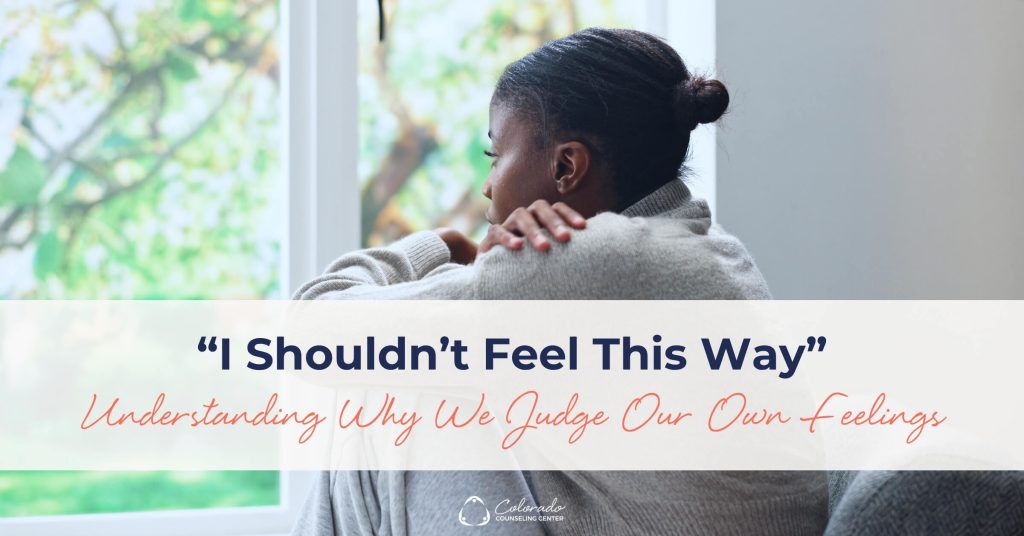
“I Shouldn’t Feel This Way”: Understanding Why We Judge Our Own Emotions

Woman resting her hand on her own shoulder, quietly processing the thought 'I shouldn't feel this way'

“I shouldn’t feel this way.” Maybe this thought showed up in the middle of an ordinary day—driving home, on your lunch break, sitting across from someone you love. A feeling arrived, uninvited, and right behind it came the judgment: I shouldn’t feel this way.

It’s one of the most common thoughts people carry, and one of the most rarely questioned. We tend to treat it as fact rather than opinion—as though our feelings are supposed to follow some internal rulebook, and when they don’t, something has gone wrong with us. But “I shouldn’t feel this way” isn’t really a statement about your emotions at all. It’s a judgment about whether you’re allowed to have them. It can also be a judgment about what these feelings say about you.

Before we can understand why that judgment shows up so quickly, it helps to look at where it usually comes from.

Continue reading

The Dangerous Pursuit of Perfection

The Dangerous Pursuit of Perfection

by Kevin Hales, LPC

Perfection is a Bad Word

Perfection has recently become a “bad word” in my vocabulary. Let me share why.

To one degree or another, we’re all guilty of pursuing perfection. For some, it is a part of their religious creed: “Be ye therefore perfect” declared Jesus to his followers. Some have actually been told by a parent: “I just want you to be perfect.” Others might simply feel the pressure to be perfect because of family expectations or the image society paints in our minds of what is and isn’t acceptable. Continue reading

When Love Feels Like Tolerance: How to Reconnect with Your Partner

Two hands barely touching, representing emotional disconnection and the effort to reconnect in a long-term relationship

“It is easy to love people in memory; the hard thing is to love them when they are there in front of you.”
– John Updike

There’s a quiet kind of relationship pain that doesn’t announce itself with a dramatic argument or a clear breaking point. It creeps in slowly. One day you realize you’ve stopped looking forward to your partner coming home. You’re not angry, exactly. You’re just… indifferent. You’re tolerating your partner more than connecting with them. You’re getting through the evenings together. You’re managing the logistics of a shared life. But the warmth? The curiosity about each other? The feeling that this person is someone you chose?

That’s harder to find.

If this sounds familiar, you’re not alone — and it doesn’t mean your relationship is broken. It means it’s doing what long-term relationships often do: drifting toward comfort or complacency and away from connection, without anyone really noticing until it’s been a while.

The good news is that drift is reversible. But it requires something most couples don’t expect: intentionality.

Here’s something that helps to understand: what looks like indifference on the surface is rarely actually indifference underneath. Most couples who feel like roommates aren’t falling out of love — they’re experiencing what happens when core attachment needs go unmet for too long. The needs that drew you together in the first place — to feel important to each other, to know your partner is truly there for you, to be loved for who you are rather than what you provide — don’t disappear over time. They go quiet. And when they do, the relationship starts to feel like logistics rather than love. Recognizing that is often the first real step toward something different.

Continue reading

What Is a Virtual Affair — and Is It Really Cheating?

Two ghosted figures sitting apart on a rocky shoreline, looking out at a gray ocean — illustrating emotional distance and disconnection in a relationship affected by a virtual affair

You weren’t looking for this. Maybe you found a thread of messages that didn’t make sense. Maybe something felt off for months and you finally looked. Maybe your partner told you, and you’ve been trying to piece together what’s real ever since.

Whatever brought you here, what you’re feeling is real — the disorientation, the sick feeling in your stomach, the questions that won’t stop coming. And the thing you’re trying to understand — whether what happened actually counts, whether you’re overreacting, whether your relationship can survive it — those questions deserve real answers.

Virtual infidelity is no longer rare. The ease of private communication, the intimacy of a phone that’s always within reach, and the blurry lines of online connection have made virtual affairs one of the most common — and most misunderstood — forms of betrayal. This post is for anyone trying to make sense of what happened and figure out what comes next.

Continue reading

Is Pornography Bad, Wrong, or Just Complicated? An Honest Look.

Sunlight filtering through a foggy forest with the text "Is Pornography Bad? An Honest Look at the Gray Areas"

Answering the question “is pornography wrong?” is worth walking through carefully. Maybe you searched this at 1 a.m., half hoping for a simple “yes” or “no” so you’d know what to do next. Maybe a partner brought it up, and you’re trying to figure out where you actually stand instead of just reacting in the moment. Perhaps you thought it was no big deal, but you’re beginning to second-guess that conclusion. Maybe you grew up hearing pornography is bad and you’re not sure anymore what you actually believe. Or maybe nothing’s happened at all — you’re just trying to figure out where you land on these issues.

Some of what gets called pornography is produced by consenting adults making their own choices about their own bodies. Some of it isn’t — and the harm in those cases is real and clear, not a matter of opinion. And some of what matters most here has nothing to do with the content itself, but with what it’s doing in your life, your relationship, or how you feel about yourself afterward. So the answer isn’t exactly a simple yes or no — but it’s not something to just blow off either. Some things are wrong. Others are genuinely complicated. And some questions only you can answer for yourself or in your relationship.

Continue reading

How to Heal from an Emotional Affair: Where to Begin

Couple sitting together outdoors at sunset, beginning to heal from an emotional affair

If your partner had an emotional affair, you may be struggling to explain why it hurts as much as it does. There was no physical contact. No hotel room. And yet something feels broken — a trust that ran deeper than you may have realized until it was gone.

Emotional affair recovery is possible. But most couples who try to heal on their own find themselves stuck in the same painful loop: one partner pushing for answers, the other becoming defensive, and both walking away feeling more alone than before. Understanding what keeps couples stuck — and what actually breaks the cycle — is where healing begins. Sometimes what keeps couples stuck isn’t conflict at all — it’s the opposite. One partner grants a quick, surface-level peace just to stop the pain, without either of you doing the real reckoning recovery actually requires. That pattern is a form of counterfeit forgiveness, and it’s worth understanding before it becomes the whole strategy.

Continue reading

When Being Right Isn’t Enough: How Connection Changes Everything

misunderstood in marriage
Choosing Connection Over Being Right: A Hidden Shift That Changes Everything

In moments of relationship conflict, many of us fall into the trap of trying to win. But as one client once said during a therapy session: “I don’t need to be right. I just need to be heard.” This honest statement highlights something powerful—the life-changing shift of choosing connection over being right.

That shift is often missed in the heat of an argument, yet it’s key to building emotional intimacy and trust. The desire to be heard is deeply human—and it’s often what your relationship needs most.

Continue reading

10 Practices of Happy Couples

10 Practices of Happy Couples – Building Lasting Love, Colorado Counseling Center

Some couples seem to weather anything — the late nights with newborns, the job losses, the years that quietly reshape who two people are — and come out the other side closer than they started. It’s tempting to think they got lucky: compatible personalities, easier circumstances, fewer hard conversations. But what really sets happy couples apart?

After years of sitting with couples in the therapy room, I’ve come to see something clearly. Happy couples aren’t the ones who avoid difficulty. They’re the ones who’ve purposefully built a handful of practices into the fabric of how they relate — 10 practices of happy couples that, over time, become the foundation of lasting connection and satisfaction. None of these are complicated. Most are even intuitive once you see them named. But naming them is what makes them repeatable.

Here are ten practices I see again and again in the relationships that last — and deepen.

Continue reading